


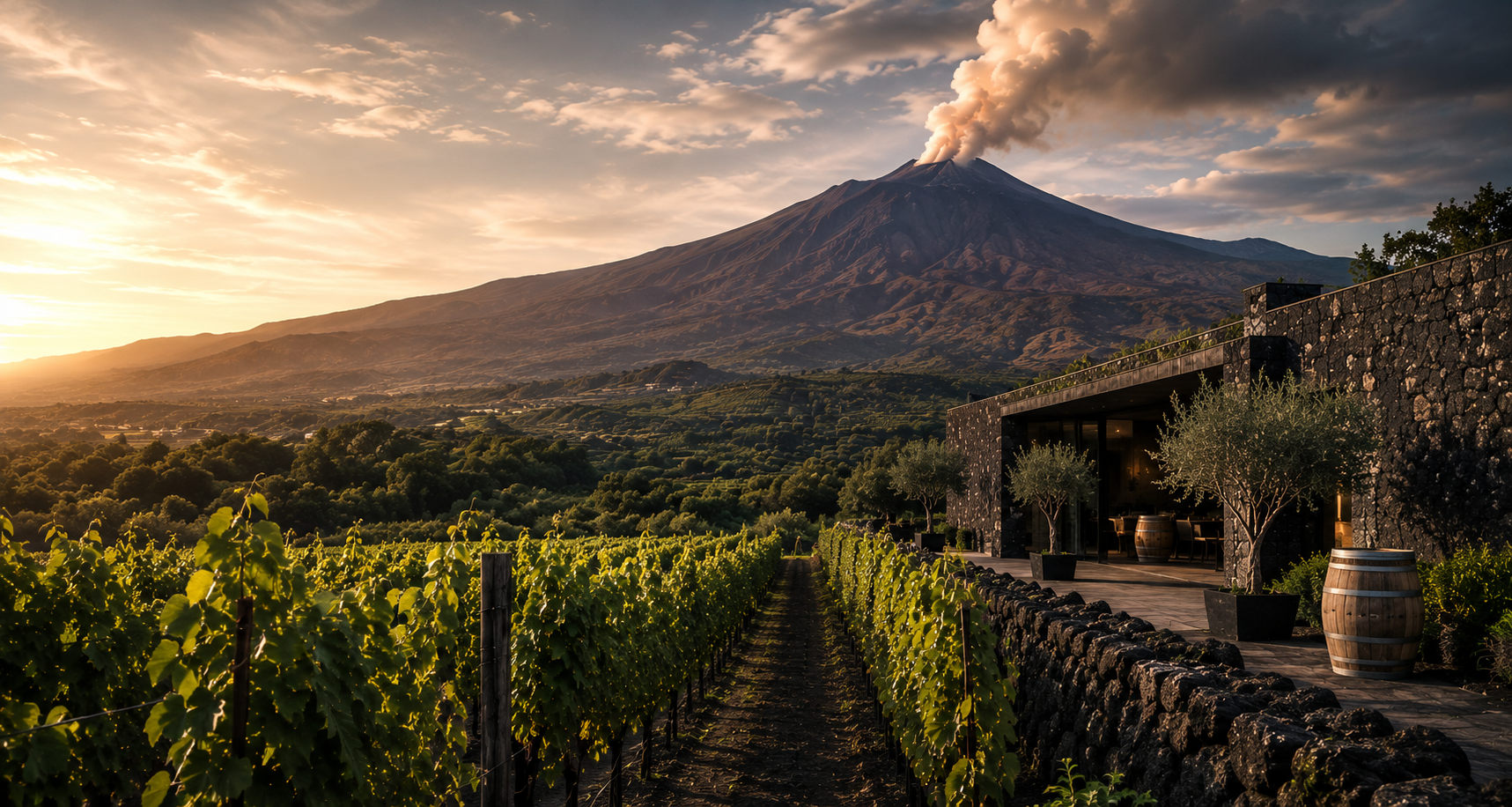
A signature banquet: Mount Etna taught me how to tell a region’s story
“There are places that teach you how to make wine. And then there are places that teach you how to plan a banquet.”
When I set off on the study trip for the Executive Wine Sommelier Master’s programme, I imagined I would be exploring an extraordinary region from a wine-growing perspective. I thought I would return with new knowledge about grape varieties, vineyard plots and winemaking techniques.
I came back with something far more important: a new awareness.
Mount Etna reminded me that a banquet does not stem from an elegantly laid table, but from the ability to tell the story of a place, its history and the people who live there.
A gourmet feast meets a mountain that ‘speaks’
The journey began even before we landed.
From the aeroplane window, I gazed upon a Sicily quite different from the one I had always imagined. On one side, the sea. On the other, the Nebrodi Mountains. And then there it was. The Mountain.
That is what the locals call Etna. Not a volcano. A presence. A living entity with which to live side by side every day.
As soon as I began walking on that black earth, I felt as though I were inside a geology book written by nature.
The ancient lava flows, the scaria, the basalt rock and the man-made terraces told the story of centuries of transformation.
Every step seemed to take me through time. It was then that I understood one of Mount Etna’s first lessons. Here, nothing has been built to impress. Every element exists because it fulfils a need. And it is precisely this authenticity that makes it so beautiful.
The landscape as a design
Among the encounters that moved me most were the ‘palmenti’. Ancient structures dedicated to winemaking which today, with extraordinary respect, have been restored and transformed into wine cellars, welcoming venues and spaces of hospitality.
I did not see restored buildings. I saw memory. I saw the ability to breathe new life into the past without erasing its identity. I found the same principle in the wineries I visited.
Pietradolce.
Fessina.
Graci.
The buildings seem to spring from the mountain itself.
Lava stone.
Green roofs.
Dry stone walls.
Materials that interact with the landscape rather than imposing themselves upon it. Even the design elements tell the story of the local area: tables carved from stone, works crafted from dried agaves, objects that do not merely decorate a space but become an integral part of it.
It is an aesthetic born of coherence. And I believe that coherence is one of the most elegant forms of beauty.
The most moving vineyards I have ever encountered
There are images I am unlikely ever to forget. The pre-phylloxera vineyards. Vines over ninety, even a hundred years old. Still supported today by chestnut poles from the surrounding woods.
Looking at them, I didn’t simply see vines. I saw individuals. Each with its own story. Its own strength. Its own personality.
The terraces look like a work of art. But they weren’t built to be beautiful. They are the result of the labour, effort and ingenuity of people who have learnt to live alongside a mountain that is as generous as it is challenging.
I stopped in one of the vineyards. Before me lay the Nebrodi Mountains. Behind me, Mount Etna. In between, humankind.
For the first time, I clearly realised just how much we are temporary guests in a landscape that has existed for thousands of years. Perhaps it is precisely this awareness that has made winegrowing on Mount Etna so respectful.
People before wine
I thought wine would be the star of the trip. I was wrong. The real stars were the people.
I met visionary winemakers. People who chose to believe in Etna when no one was yet talking about it as one of the world’s great wine-growing regions.
They invested before success came. Before international recognition. Before the market proved them right.
But what struck me even more was the relationship between them. I sensed no competition. I sensed no rivalry.
I saw respect.
Collaboration.
Sharing.
It seemed as though everyone was working towards a common goal. Not to promote their own name. To promote Etna.
This is perhaps the most beautiful lesson I take away with me. When the region itself takes centre stage, people’s work takes on a different meaning too.
Wine as the voice of the land
During our journey, we tasted numerous Carricante and Nerello Mascalese wines.
Each glass told the story of a different vineyard district.
Different altitudes.
Different lava flows.
Different soils.
They weren’t simply wines. They were liquid interpretations of the landscape.
Of all the tastings, one has remained particularly close to my heart: the one organised at Cottanera.
For the first time, I truly grasped how a different lava flow can profoundly alter a wine’s identity. Each vineyard seemed to possess its own voice.
The Carricante spoke with verticality, tension and savouriness.
The Nerello Mascalese, on the other hand, conveyed elegance, depth and a surprising ability to stand the test of time without losing its balance.
I realised that wine is not the protagonist. It is the language. It is the medium through which a territory chooses to tell its story.
Hospitality that cannot be manufactured
There is an image I cherish with particular fondness. A drizzle of extra virgin olive oil poured over a slice of homemade bread, served in a small Sicilian ceramic dish. A very simple gesture. Yet one that speaks louder than a thousand words.
Etna is a bountiful land.
Citrus fruits.
Olive trees.
Peaches.
Avocados.
Wild herbs.
Every winery welcomed us with natural warmth. Never with ostentation. Hospitality was not a marketing tool.
It was culture.
It was identity.
It was the most authentic way of saying to us: ‘Welcome home.’
When I first began to imagine a wedding
It was in places like Radicepura and Cantine Nicosia that my mind began to do what it always does: plan.
I imagined long banquet tables. Linen tablecloths and antique lace. Sicilian citrus fruits woven amongst the flowers. Small handcrafted ceramics. ‘Teste di Moro’ reinterpreted with contemporary elegance. Candles. Lava stone. Hand-blown glass. Prickly pears. Olive trees.
No folklore.
No contrived sets.
Just authentic elements, capable of telling the story of that land with respect.
It was at that moment that I realised something. A wedding shouldn’t merely take place in a venue. It should belong to that place.
The Meaning of a ‘Signature Banquet’
I have been using this expression – ‘Signature Banquet’ – for many years.
But on Mount Etna, I came to understand its meaning even more clearly. A banquet is not merely a succession of courses. It is not a staged display. It is not a tableau. It is not an impeccable mise en place.
It is a narrative.
Every choice should stem from the culture of the place hosting that moment:
The wine.
The food.
The materials.
The aromas.
The light.
The people.
Everything should contribute to telling a single story. Because that is what makes a reception truly memorable. Not perfection, but identity.
The greatest gift Mount Etna has given me
When I got home, I realised that this trip hadn’t just taught me something about wine. It had reminded me why I love my work so deeply.
Every region has its own culture.
Every culture has its own cuisine.
Every cuisine tells the story of a community.
And that is precisely where a ‘Banchetto d’Autore’ begins. Not from a desire to impress, but from the wish to transform a reception into an experience capable of leaving a lasting memory.
Because a banquet, even before it is a social occasion, is a cultural act. It is memory, connection, identity.
And this is perhaps the most precious lesson that Mount Etna has taught me. A mountain that does not merely teach us how to make great wines. It teaches us to listen to the land. And, through it, to tell the stories of people.
Monica Indaco
Sommelier
Creator of the ‘Banchetti d’Autore’ concept
Food and wine curator for weddings that celebrate identity